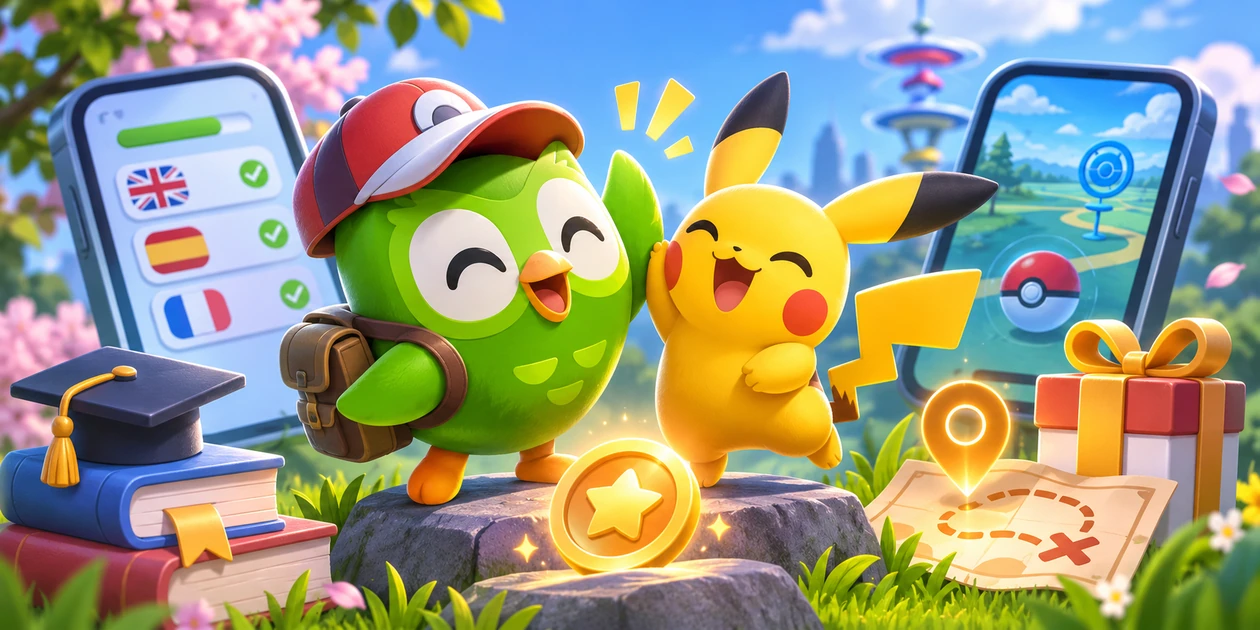
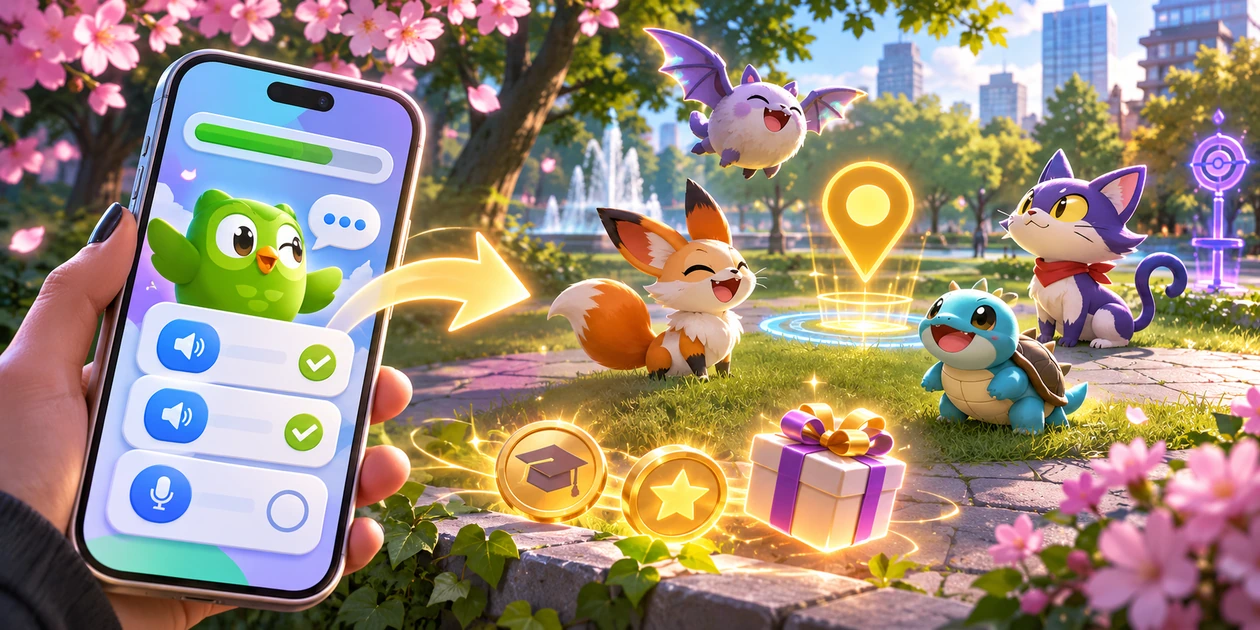
One more language lesson can now bring you closer to an adventure in Pokémon GO. Duolingo’s Pokémon collaboration connects learning with themed rewards and, after enough qualifying days, an offer code for a special research quest in the game.
At first glance, it looks like a familiar crossover built around costumes and recognisable characters. The more interesting part comes after switching apps: Pokémon GO lets participants read research tasks in a language they choose. That gives returning learners a concrete reason to start again. It also changes how they should plan their participation, because completing everything in a single evening is not an option.
Getting started with Duo’s Pokémon Party
The event began on November 17, 2026. The official Pokémon GO announcement describes Duo’s Pokémon Party as a limited-time quest in the latest Duolingo app. Join the quest and complete a lesson in any course to earn the first reward, then continue on further learning days.
The research code requires at least seven lessons on seven different days. Seven lessons back-to-back do not meet that condition. The published wording specifies different days, so it should not be silently rewritten as a requirement for seven consecutive days.
A sensible first step is to find the event card and confirm that you have joined. After finishing a lesson, check that the day registered. Doing this early is easier than reaching the end of the month and discovering that your usual learning activity did not produce the event progress you expected.
Three deadlines, rather than one
The promotion has separate stages, and completing one does not automatically complete the next. The event calendar maintained by Leek Duck also distinguishes the learning activity from the research it unlocks. Simply remembering that the event ends in December is not enough.
The code unlocks research, not an instant collection
Redeem the earned code on the Pokémon GO Web Store’s code redemption page, signed in to your game account. Before confirming, make sure it is the account on which you want to complete the research.
The game’s rewards include XP, Stardust and encounters with Pikachu, Meowth, Chatot and Lucario with a Special Background. Shiny encounters are possible, rather than guaranteed. Receiving the code does not mean every reward has already arrived: the research tasks still need to be completed and the rewards claimed before the deadline.
That distinction is especially useful for someone who currently uses only Duolingo. A lesson does not instantly deliver a Pokémon. It opens a route into a second app with its own activity to complete. Decide whether that extra activity sounds enjoyable before treating the reward as another obligation on your calendar.
What the language element adds
Participants choose a language for the research tasks, with Professor Willow offering hints. The interesting possibility is contextual reading: instead of recognising an isolated translation, you need to understand what a familiar game is asking you to do.
Certain Pokémon obtained through the event also have a Language Tag on their summary page. Tapping it reveals their names in other languages. This is a feature associated with particular event Pokémon, rather than a promise that every creature already in your collection will receive the same change.
There is no need to exaggerate the educational impact. A themed research quest can provide a reason to read a few commands more carefully. It cannot replace a structured course or conversation practice. Its most useful role is as an invitation back to a learning goal you already care about, with the game providing a little extra encouragement.
For example, a learner could note one unfamiliar instruction, work out its meaning, and try to recognise it next time without immediately checking a translation. That is a suggested way to approach the event, not a separate requirement or a guaranteed learning outcome.
The costumes have an expiry date
Duolingo offers up to four Pokémon-themed avatar suits. A detail in Duolingo’s own announcement deserves attention: the suits are usable until March 31, 2027. They should not be described as permanent additions to an account’s wardrobe.
If the event card is missing, update the app and check official in-app information and regional service availability. The announcement does not establish that every account in every country will show an identical screen at the same moment. Buying a subscription or repeatedly reinstalling the app without identifying the issue is not a sensible first response.
For people who already enjoy both services, the appeal is straightforward: today’s lesson gives them another reason to return tomorrow. The more lasting benefit, however, would come after the costumes disappear and the research ends—if those seven learning days become a routine worth continuing without a prize attached.