
Everything makes sense while a teacher works through an example. Then you face a similar problem alone and cannot decide where to begin. Coding has its own version of this experience: a short video explains a loop clearly, yet a few lines of your own code behave nothing like you expected.
Brilliant focuses on that gap between recognising an explanation and applying an idea independently. Its maths and coding activities ask learners to interact with problems, with an AI-powered tutor called Koji available across many topics. This is a look at the learning experience available in November 2026, rather than an announcement of a newly launched product.
What learning through interaction means
Brilliant’s current subject range extends from mathematical foundations to algebra, calculus, statistics, Python and computer science. The more useful question is how you work through a topic: the platform asks you to take actions, test assumptions and examine the results.
One illustration used by the service is exploring derivatives by moving a tangent line and observing its slope. A formula acquires something visible to refer to. That can be an appealing starting point when you recognise a textbook definition but struggle to picture what it describes.
A useful habit is to predict what will happen before moving anything. What should change, and why? The interaction then becomes a test of your reasoning. Moving objects until the right answer appears, by contrast, can leave you with a completed exercise but little understanding of how you reached it.
Koji knows which problem you are working on
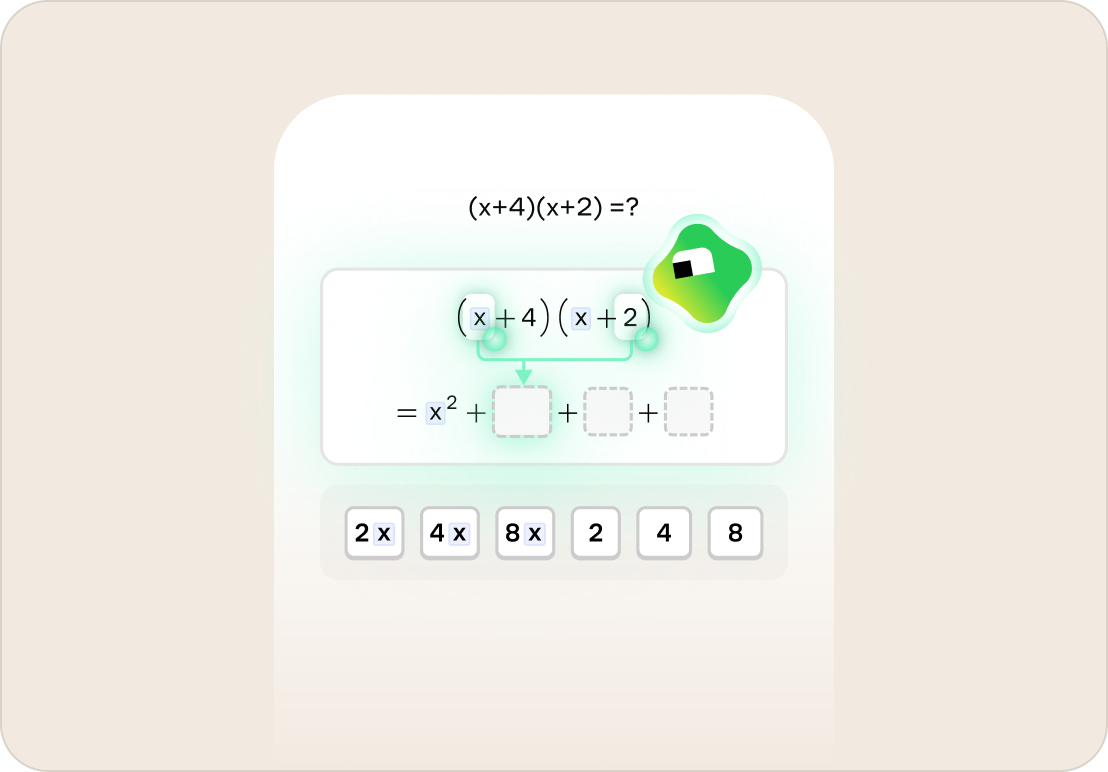
In its explanation of how Koji works, Brilliant describes a tutor with access to the current exercise, its interactive components and your attempted answers. It can highlight part of a diagram and guide you with questions. That refers to context inside the learning experience, not observation of everything happening on your device.
The practical attraction is continuity. If one step is confusing, you do not have to reconstruct the entire problem each time you ask for help. The intended approach leaves the thinking with the learner. Someone primarily seeking an immediate finished answer may therefore find that the product is designed around a different goal.
You can judge a hint by what happens afterwards. Hide the explanation and try to describe the reasoning in your own words. If that remains difficult, return to the uncertain step. A correct answer is encouraging, but it does not yet show that you could repeat the reasoning without support.
Coding is also about understanding consequences
For beginners, the difficult part is often not typing a command but understanding what follows from it. Why did a condition succeed? How many times will a loop run? What happens when a list contains no items? These questions move learning beyond copying a working example.
Brilliant emphasises code reading, logic, debugging and systematic problem-solving. Its own account of curriculum coverage also advises learners to add projects and separate study in areas such as web development and version control.
That bridge to independent work can be small. After learning conditions, try building a simple delivery-cost calculator. After working with lists, process a handful of expense entries. These are editorial suggestions for follow-up practice, not claims about particular lessons in the catalogue. They help reveal whether an idea that made sense inside an exercise still makes sense in a different setting.
Who may find the format useful?
Adults returning to maths can begin with a specific gap. Percentages or probability may be a sensible starting point if they are what makes a work report difficult to interpret. There is no need to turn the first session into a commitment to complete an entire subject.
For a school student, compare the topics you need with the school syllabus. An app’s teaching sequence does not necessarily match a local textbook. For an aspiring programmer, a helpful measure is whether you can explain and modify a short program without relying on a completed template. In each case, a concrete outcome says more than the number of lessons ticked off.
There is also a clear limitation for people seeking formal credentials: Brilliant does not issue course-completion certificates, academic degrees or professional certifications. Evaluate it for the learning it supports, and look separately for any credential your study or career plans require.
What the free plan includes
The official Free and Premium comparison gives free users two keys a day, with each key opening a learning concept or practice set. Progression is sequential, occasional ads appear, and access to Koji is a limited preview.
Premium removes those daily limits and ads, allows movement directly to particular concepts and provides full access to the tutor. Check the price offered for your location and purchasing method rather than assuming that one amount applies everywhere.
Before paying, give yourself several actual learning sessions. Do you want to return? Are the explanations useful? Is the daily cap really holding you back, or is the problem finding time to study? Those answers provide a better basis for a subscription than an ambitious schedule that has not yet become part of your week.
Language, devices and a manageable routine
According to Brilliant’s official FAQ, the service works in a browser and through its iPhone, iPad and Android apps, with progress syncing across supported devices. Lessons require an internet connection; they cannot be downloaded for complete offline study.
The company says Koji can communicate in many languages, while deeper multilingual support within learning materials is still being developed. Before subscribing, check the language of questions, labels and explanations in your chosen topic, as well as the tutor’s responses. A multilingual conversation does not automatically mean an entirely translated course.
A manageable starting point is a short session with one goal: understand a particular principle, then use it once more without a hint. The moment when you can explain why a solution works provides a much more meaningful reason to come back than simply keeping a counter moving.