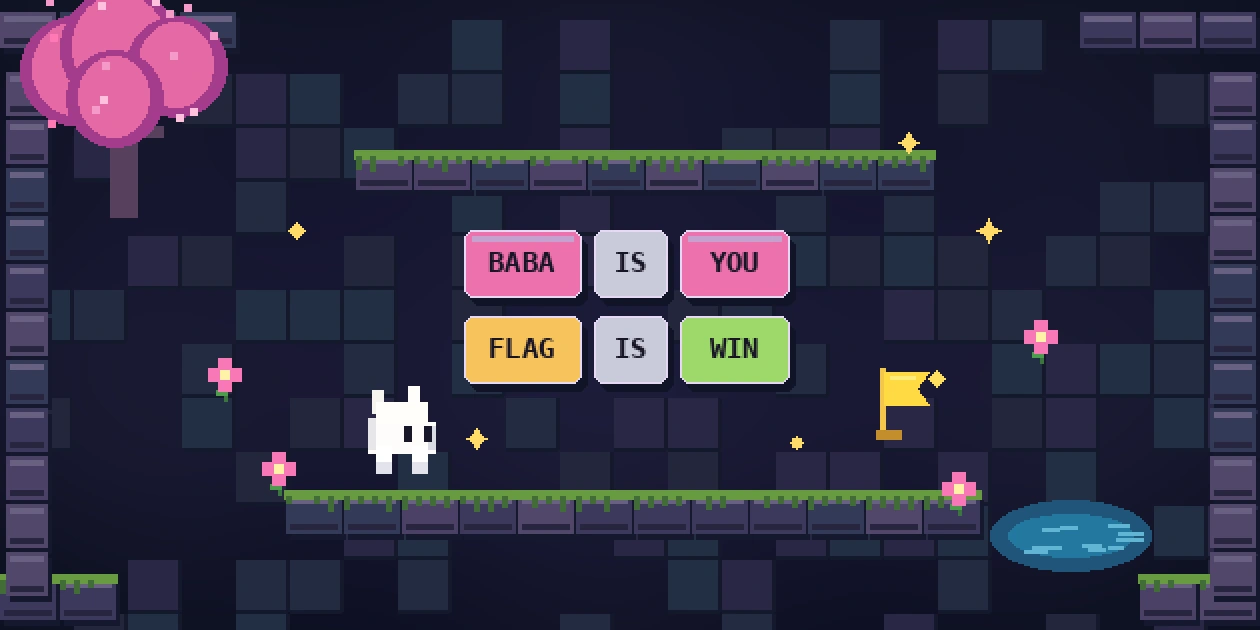
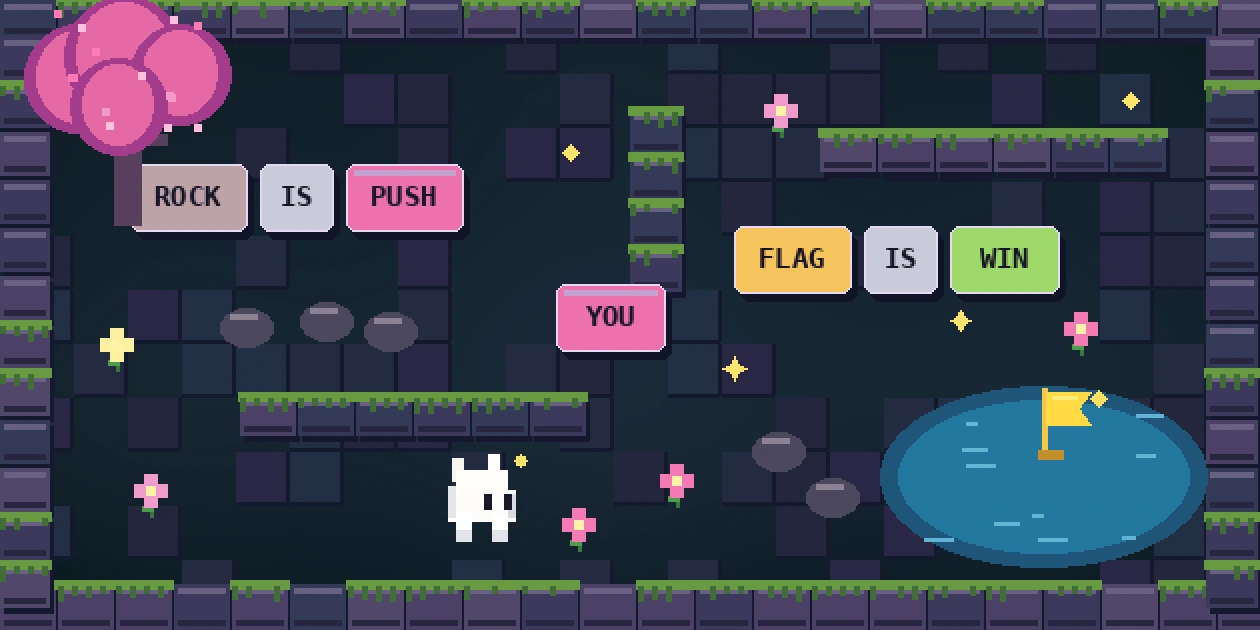
A wall blocks the route, a flag waits beyond it, and a little white character apparently needs to find a way around. It looks like a familiar puzzle. Baba Is You asks you to look at the words nearby first. Perhaps the wall is only an obstacle because a particular sentence currently says it is.
Hempuli’s game turns rules into objects you can move. The familiar question of where to go becomes something more interesting: what would have to change for that route to become possible? This is a closer look at an existing game, rather than a new release announcement. Baba Is You originally reached PC in 2019, and its central idea remains a compelling reason to discover it.
The words matter as much as the objects
The developer’s official Baba Is You page describes rules as physical objects within the game world. They are not instructions you read once and then forget. Their position is part of the puzzle itself.
Consider a basic example. WALL IS STOP gives a wall its blocking property. If the layout lets you break that sentence, the rule making the wall an obstacle no longer applies. Replacing the property with PUSH can instead make it movable. These examples depend on the available pieces and their arrangement: you cannot type any convenient command into the game.
That restriction makes the idea interesting. A useful word might be trapped against an edge or embedded in another rule you still need. Understanding the change you want is only half the challenge. You must also work out how to make it without destroying the conditions that let you continue.
A small board does not mean a small challenge
Many puzzle games teach a stable set of rules and then ask you to find the right sequence of moves. Here, you must keep track of both the arrangement of the objects and the properties they currently possess. Moving a single word can change how several familiar things behave.
It is easy to keep looking for a route to the goal while overlooking the possibility that the goal itself could change. Equally, you may cling to an assumption about what you control because it seemed obvious at the start. The Steam listing describes more than 200 levels, but the appeal is not simply having a long checklist. It is meeting different challenges to your starting assumptions.
The spare visual style supports this approach. With relatively little decoration competing for attention, relationships become the focus. That does not make the puzzles gentle. Anyone expecting a steady stream of effortless victories should understand that the friendly appearance hides a game willing to leave you thinking.
What to do when nothing seems to work
Try stating a prediction before making a move: if I break this rule, what should change? Then test that prediction alone. An unsuccessful attempt can still tell you something useful, whereas moving several things at random makes it harder to understand what happened.
Undo is especially valuable here. It lets you compare alternatives without replaying every earlier step, a feature also highlighted in the editorial description on the App Store. It makes experimentation easier to sustain: an incorrect idea need not cost a lengthy reconstruction of the board.
When you notice yourself repeating the same sequence without learning anything, a break may be more useful than another attempt. On returning, read the active rules again before retracing your old route. If you want help, a small conceptual hint will often preserve more of the pleasure than a complete list of moves. The valuable part is seeing why a solution works.
An interesting thinking game, without grand promises
Baba Is You asks players to test assumptions, read conditions carefully and consider alternatives. Those are meaningful features of the activity. They do not establish that playing it will raise IQ, improve memory or produce broad benefits outside the game. It is better understood as an engaging logical challenge than a universal brain-training product.
Playing alongside a child can turn it into an enjoyable conversation. What do you think this word does? What will happen if we move it? The adult’s role need not be to supply the solution. Leaving space for a mistaken prediction gives both players something to examine. A content age rating should not be confused with a promise that a young child will find the puzzles easy.
Choosing between computer and mobile
The desktop edition is available for Windows, macOS and Linux, including through Hempuli’s itch.io page. There are also iPhone and iPad versions and an Android edition on Google Play. Check your local store for price and compatibility rather than treating one region’s listing as universal.
A larger display is useful when you want to study the board or discuss it with someone beside you. A phone makes it convenient to try an idea during a short break, although a small board does not guarantee a quick solution. The best choice is the device on which you can comfortably concentrate.
Baba Is You is particularly appealing if you enjoy discovering why an obvious approach fails. Its reward is the instant an apparently fixed obstacle becomes something you can reconsider. You stop seeing a dead end and start seeing a rule you have not yet tried to change.